READYING THE CHARTER WEEK
Saturday afternoon on a busy charter pontoon in Split, Lefkas, or Road Town is hot, noisy, and hurried. When six crew members arrive simultaneously with luggage bags, grocery boxes, and high expectations, it is tempting to rush the technical handover just to slip the dock lines before sunset. Yet twenty calm minutes spent verifying ground tackle, water manifolds, and crew roles on Day 1 saves hours of troubleshooting in a remote bay on Day 4.
LICENSING, VHF CERTIFICATES, AND CREW LISTS
What Port Authorities Inspect Before Issuing Transit Logs
In nearly all Mediterranean jurisdictions (Greece, Croatia, Italy, Spain), bareboat charter regulations require the skipper to carry an original physical certificate of competence—typically an ICC (International Certificate of Competence), RYA Day Skipper or Yachtmaster practical, or ASA 104/106 with IPC endorsement. Croatia strictly requires a valid VHF Short Range Certificate (SRC) on board, while Greek port police frequently require a co-skipper declaration or second qualified crew member to sign off on the official crew list.
In the Caribbean (British Virgin Islands, Antigua, Grenadines), charter bases assess a detailed sailing résumé demonstrating command experience on vessels of comparable length and hull configuration (monohull vs. catamaran), often offering a half-day check-out captain if your recent logbook hours are light.
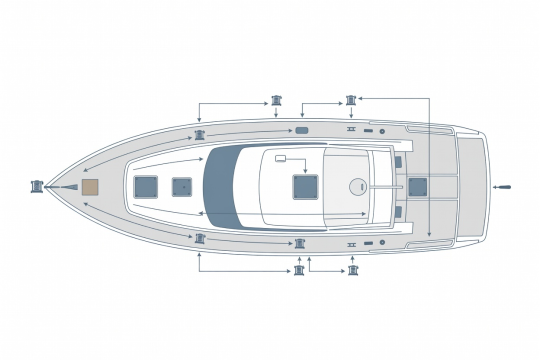
Deck inspection callouts — verify location of seacocks and breakers with base engineer.
THE 12-POINT TECHNICAL HANDOVER CHECKLIST
Divide your party on arrival: assign half the crew tostow soft duffle bags and chill perishable provisions while the skipper and first mate walk the vessel bow-to-stern with the base technician uninterrupted.
- 01. Electric Windlass & Bitter End: Run the anchor down two metres and back up under load; verify how the bitter end is secured with a rope lanyard inside the chain locker.
- 02. Windlass Breaker & Clutch Handle: Locate the heavy-amp thermal reset switch (usually behind the saloon panel or aft cabin berth) and test the manual gypsy clutch handle.
- 03. Water Tank Manifold Valves: Never leave both freshwater tanks open simultaneously; run Tank 1 dry first, then switch the floor valve to Tank 2 so you always know your true reserve.
- 04. Holding Tank Gravity Valves: Confirm whether heads use gravity discharge or electric macerators, and review the golden rule to prevent blocked pipes.
- 05. Engine Raw-Water Strainer & Impeller: Shine a torch through the transparent sea-water strainer basket under the companionway steps and confirm spare impeller and fan belt storage.
- 06. Sails, Reefing Lines & Furling Lead: Unroll 20% of the genoa and mainsail on the dock (if wind allows) to check that furling lines are neatly drum-wound without overrides.
- 07. Dinghy Oars, Painter & Outboard Kill-Cord: Pump the inflatable tubes firm, start the outboard in neutral, check the fuel mix (2-stroke vs. 4-stroke), and secure a spare kill-cord clip.
- 08. Shore Power Cable & Adapters: Check the 16A/32A shore power lead and verify the battery charger amperage on the DC panel before unplugging.
PROVISIONING FOR ISLAND-HOPPING RHYTHMS
Stocking for Noon Anchorages, Dining Ashore at Dusk
The classic provisioning error is buying seven nights of heavy dinner meats that overwhelm a 12-volt top-loading yacht fridge and go unused while the crew eats ashore at waterfront tavernas or beach grills. Instead, structure your provisioning around the actual rhythm of island-hopping:
100% of Breakfasts & Lunches Aboard: Stock generous quantities of local cheeses, cured meats, tomatoes, olives, flatbreads, pasta, tinned tuna, fruit, and coffee for midday swim-stop lunches. Two "Backup" Anchor Dinners: Carry shelf-stable ingredients for two hearty one-pot dinners during nights spent in uninhabited bays like Dokos or the Tobago Cays. Water Rationing: Calculate 2 litres of bottled drinking water per person per day stowed under the saloon floorboards, reserving tank water strictly for washing and cockpit showers.
BUILD YOUR ROUTE BRIEF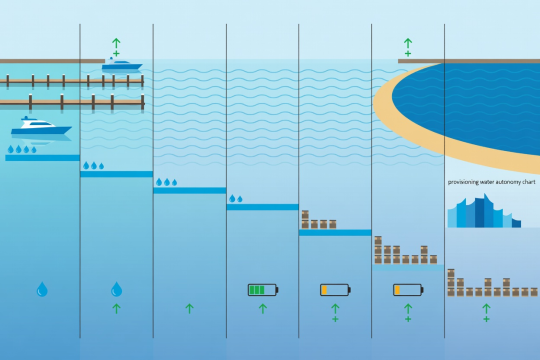
Resource cadence diagram for a 6-person charter crew.