HARBOURS, BERTHS AND BAYS
The character of a yacht charter day changes completely depending on how and where you secure the vessel. A full-service marina offers hot shore showers, effortless battery charging, and supermarket trolleys right to the passarelle, yet too many consecutive marina nights turn a sailing holiday into an expensive floating caravan park. Conversely, five straight nights free-swinging in deserted bays can leave a family crew short on fresh water, ice, and ashore exploration.
Understanding the four stop archetypes—and how to execute their deck routines cleanly—lets you stitch together an itinerary with effortless variety.
MARINA LAZY LINES VS. TRADITIONAL TOWN QUAYS
Mastering Stern-To Mediterranean Approaches
In organized marinas across Croatia, Italy, Turkey, and major Greek hubs (such as Gouvia or Alimos), you berth stern-to using a lazy line (slime line). A light messenger rope attached to the quay leads to a heavy submerged mooring line secured to a concrete block on the harbour bed. As you reverse into your assigned slot, a crew member picks up the messenger line at the stern with a boathook and walks the heavy line forward to the bow cleat while the helm tensions the windward stern warp first.
On traditional municipal town quays—such as Hydra, Poros, Symi, or Fiskardo—there are no lazy lines. You must rely on your own bow anchor. Line up four boat lengths dead perpendicular to your chosen gap on the stone wall, drop the hook in clear sand or mud, and pay out 35 to 50 metres of chain while reversing steadily. Once the stern is two metres off the quay, snub the chain hard so the anchor sets firmly, then pass both stern lines ashore and tighten the chain until the gangplank sits comfortably out of range of underwater masonry.
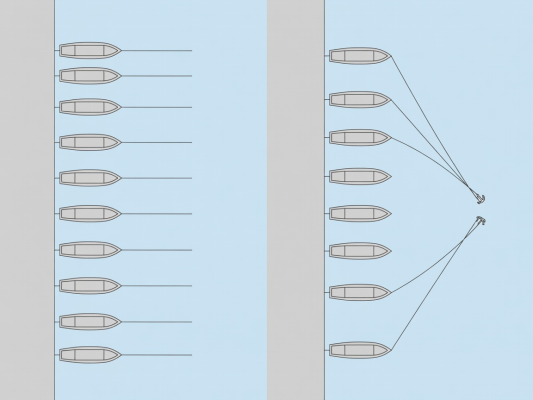
Schematic deck geometry for stern-to approaches — always check underwater ballasting blocks near old stone quays.
FREE-SWINGING BAYS VS. LONG LINES ASHORE
Reading Seabed Holding and Securing in Deep V-Shaped Coves
When anchoring for a midday swim or an overnight stay in wide, gently shelving bays (such as Ormos Vlicho or Cane Garden Bay), standard free-swinging technique applies: choose a bright sand patch in 4 to 8 metres of water, avoid dark Posidonia oceanica seagrass meadows (which offer poor hook penetration and are ecologically protected across the Mediterranean), and pay out at least a 5:1 scope of chain before backing down at 1,800 RPM while snorkelling over the anchor to confirm it is buried fluke-deep.
In narrow, steep-sided coves across the Ionian, Sporades, and Turkish Turquoise Coast, the seabed plunges to 15 metres just two boat lengths from the pine trees. Free-swinging here requires too much room. Instead, drop the anchor in 12 to 15 metres down the middle of the cove, reverse toward the shore until the stern sits in 3 to 4 metres, and swim or dinghy two 50-metre floating polypropylene lines ashore to tie around sturdy rocks or tree trunks at a 45-degree angle.
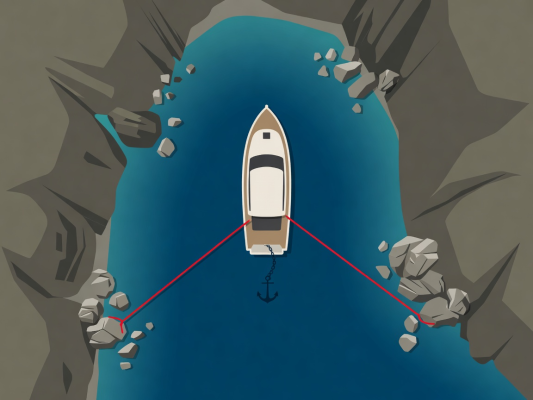
Schematic long-line cove geometry — use floating warps to avoid fouling the propeller.
HARBOUR-VERSUS-BAY COMPARISON
| Stop Archetype | Typical Cost / Night (42ft Yacht) | Primary Advantage | Key Watch-Out for Skippers |
|---|---|---|---|
| Private / ACI Marina | €90 – €220 (seasonal & length dependent) | Guaranteed berth, 220V shore power, unlimited water, marinero assistance | Crosswind drift inside tight fairways; keep 2 knots steerage in reverse |
| Greek Municipal Quay | €10 – €35 (plus token pillar for water/power) | Step directly onto historic waterfront squares and tavernas | Crossed anchors from late arrivals and ferry wash pushing hulls toward stone steps |
| Konoba / Park Mooring Buoy | €40 – €90 (or free with dinner ashore) | No anchor dragging risk; rapid evening setup after a long sail | Inspect the top swivel and run a secondary bridle line through the buoy ring |
| Secluded Swimming Bay | €0 | Total privacy, morning swims off the transom, stargazing without dock glare | Nighttime wind shifts or katabatic downdrafts off steep leeward hills |